
Looking for collaboration for your next project? Do not hesitate to contact us to say hello.
Looking for collaboration for your next project? Do not hesitate to contact us to say hello.


We are here to answer any question you may have. Feel free to reach via contact form.
We deliver Ecommerce SEO solutions designed to improve how your products and category pages are discovered, understood, indexed and found across Google and AI-powered search. .
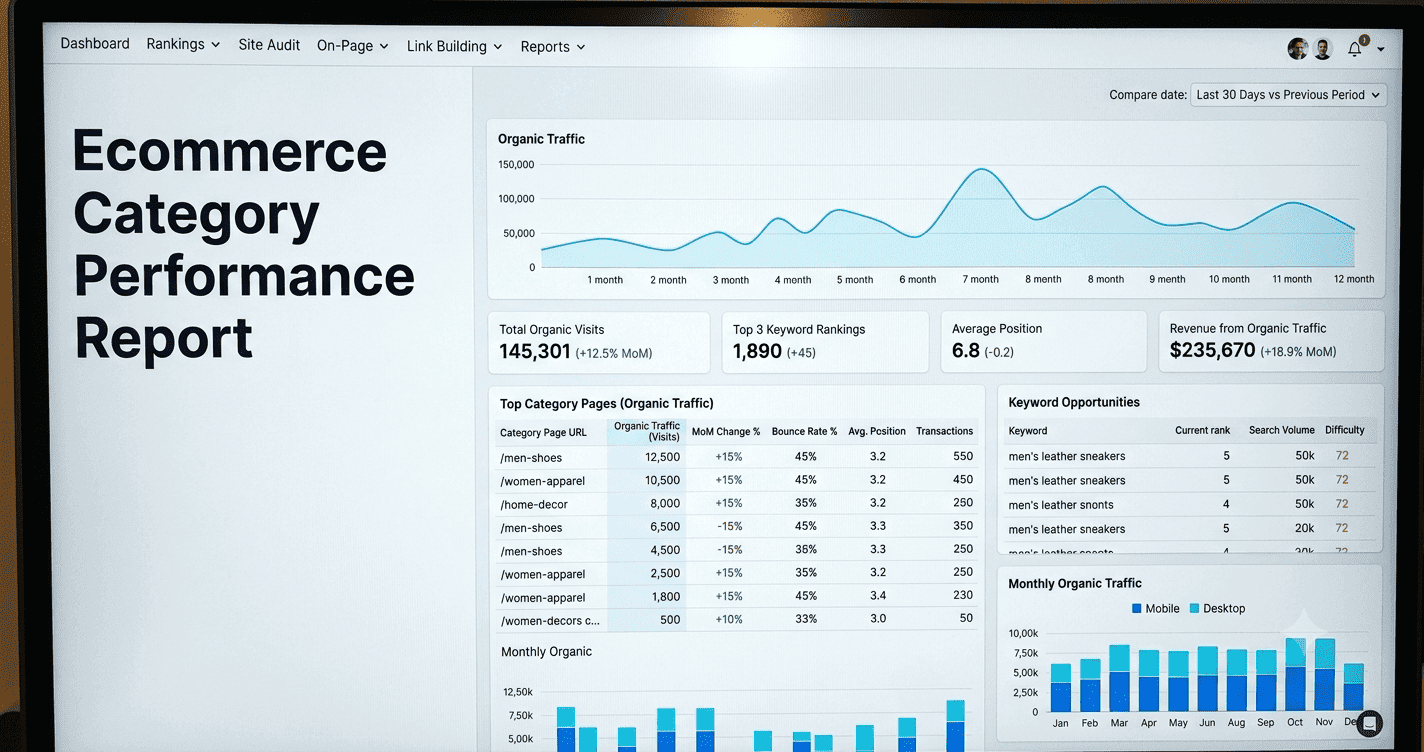
Most online stores fight the wrong battle. A founder spends months perfecting product photography and checkout flow, then wonders why Google can’t find half their catalog — because faceted navigation quietly generated ten thousand duplicate URLs nobody planned for.
That’s the actual work of ecommerce SEO: fixing the technical mess large catalogs create, then making sure product and category pages actually answer what shoppers are searching for.
Ecommerce SEO is the practice of getting your online store’s product and category pages to rank in search, so shoppers find and buy from you without paid ads. That’s the whole idea in one sentence; everything below is how we actually do it.
This is different from ecommerce development, which builds or migrates the store itself. This page assumes you already have a store — the work here is making it rank and convert, not building it from scratch.
Product and category pages carry the ranking weight, not blog content. Most ecommerce organic traffic comes from those pages directly, with blog content contributing a much smaller share — which is why we prioritize catalog structure before content marketing.
Faceted navigation is the technical problem that trips up almost every growing store. Filters for size, color, and price can generate thousands of near-duplicate URLs, which buries genuinely valuable pages and wastes the crawl budget search engines give your site.
Structured data has become closer to a requirement than an optimization. Product schema needs to match your actual page content and merchant feed exactly — a mismatched price or stale availability status is a trust problem for search engines and AI systems alike, not just an SEO one.
Platform matters for how this work actually gets done:
| Platform | Common technical issue |
|---|---|
| Shopify | Limited native control over URL structure and canonical tags |
| WooCommerce | Plugin conflicts generating duplicate Product schema |
| Magento | Complex faceted navigation, layered category URLs |
| BigCommerce | Product variant URL handling across large catalogs |
We adjust the technical approach to whichever platform you’re actually running, rather than applying one generic checklist.
Free duplicate-URL check
We'll check your catalog for faceted-navigation duplicates and crawl waste — no obligation.
Shopping is shifting into AI conversations, not just search results. Google’s AI Overviews now appear on 14% of shopping queries, a 5.6x increase in just four months, per 2026 data — and ChatGPT’s shopping research feature pulls product recommendations directly into the conversation before a shopper ever visits a site.
Structured data is what makes this possible. 65% of pages ChatGPT cites include structured data, and brands with 9 or more structured product facts achieve roughly 78% average AI coverage, against just 9% for brands with two or fewer, per 2026 benchmark data across 500+ brands.
In practice, this means product schema completeness now does double duty — the same clean data that earns rich results in Google also determines whether an AI shopping assistant can confidently recommend your product by name.
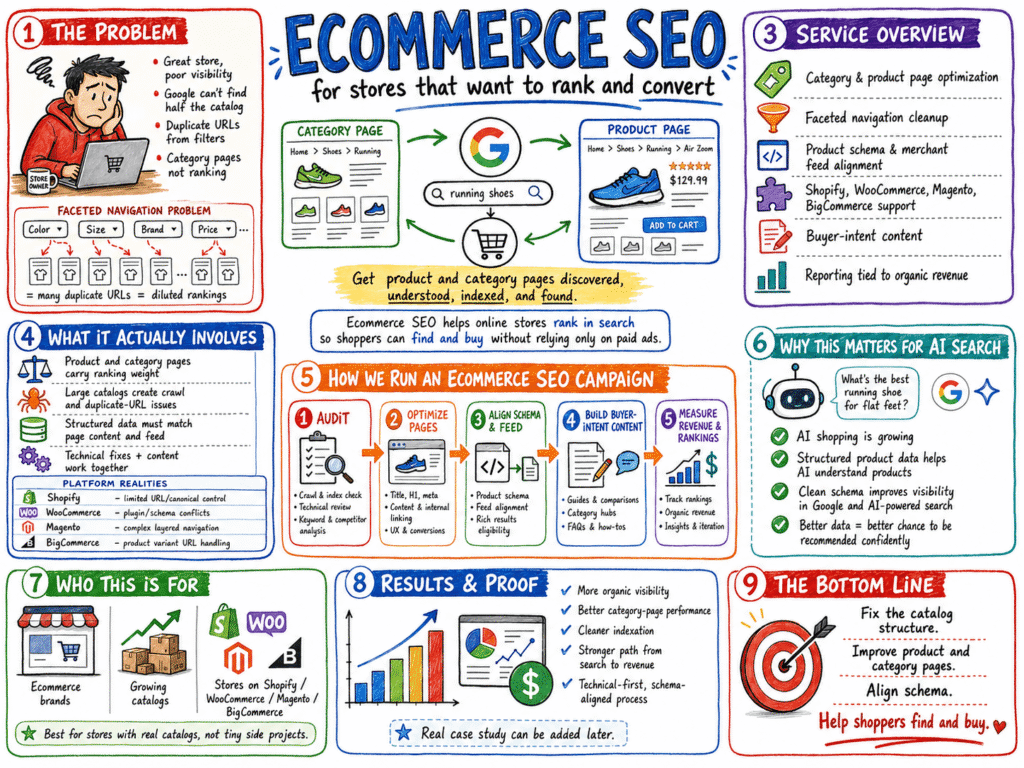
This service fits ecommerce brands running Shopify, WooCommerce, Magento, or BigCommerce stores with real catalogs — not a five-product side project. If your category pages aren’t ranking, or Google Search Console shows thousands of pages you never intended to create, this is the work that fixes it.
Growing stores with a few hundred to a few thousand SKUs get the most from this service, since faceted navigation problems compound as a catalog scales. Smaller stores often benefit more from technical SEO fundamentals first.
23.6% of ecommerce orders come from organic search, per 2026 industry data — making it one of the largest addressable channels most stores have, alongside paid and direct traffic. Separately, industry pricing data shows most stores investing $2,500–$10,000+ per month see the strongest returns when technical fixes and content work run together, rather than either one alone — a second, independent data point pointing the same direction.
What we can say honestly about our own work: our ecommerce SEO campaigns follow the same technical-first, schema-aligned process described above, applied consistently across client engagements. We don’t yet have a published, named case study specifically for ecommerce SEO to link here. That’s coming as current campaigns complete, and we’d rather say that plainly than dress up a number we can’t stand behind.
Catalog SEO, AI shopping, and pricing data from published 2026 industry research — not a single-store report.
What is ecommerce SEO? It’s the practice of optimizing an online store’s product and category pages, technical structure, and content so they rank in organic search and get found by shoppers without paid ads.
How is ecommerce SEO different from regular SEO? Scale and technical complexity. A 5,000-product catalog with faceted navigation creates duplicate-URL and crawl-budget problems a 10-page services site never encounters, which is why ecommerce SEO leans more heavily on technical work.
What does an ecommerce SEO agency actually do? Audits and fixes technical issues (duplicate URLs, crawl problems), optimizes category and product pages, aligns product schema with merchant feeds, and builds buyer-intent content — then reports on organic revenue.
How long does ecommerce SEO take to show results? Most stores see early movement within 2–4 months and meaningful gains by month 4–8, with results compounding from month 9 onward, per 2026 industry data. Larger catalogs with more technical debt typically take longer than smaller ones.
How much does ecommerce SEO cost? Most growing stores invest $2,500–$10,000+ per month depending on catalog size and competition, per 2026 agency pricing data. Small stores with limited catalogs sometimes start lower, while enterprise catalogs can run $15,000–$50,000+.
Does ecommerce SEO help with AI shopping assistants like ChatGPT? Yes — the same product schema and content-quality work that improves traditional rankings is what AI shopping tools rely on to confidently recommend a product, particularly as more shopping research moves into conversational AI.
Ready to see exactly how many of your catalog pages are actually working for you? Get your free SEO audit → No obligation, no generic pitch — just a real look at your store’s search performance.


Trustpilot reviews

It was difficult to pick only one reasoning for the 5 star rating, in fact all the features are top notch. I love the design, and the pre built elements make your life a hell of a lot easier.

It was difficult to pick only one reasoning for the 5 star rating, in fact all the features are top notch. I love the design, and the pre built elements make your life a hell of a lot easier.
It was difficult to pick only one reasoning for the 5 star rating, in fact all the features are top notch. I love the design, and the pre built elements make your life a hell of a lot easier.
It was difficult to pick only one reasoning for the 5 star rating, in fact all the features are top notch. I love the design, and the pre built elements make your life a hell of a lot easier.

Adding {{itemName}} to cart
Added {{itemName}} to cart


