
Looking for collaboration for your next project? Do not hesitate to contact us to say hello.
Looking for collaboration for your next project? Do not hesitate to contact us to say hello.


We are here to answer any question you may have. Feel free to reach via contact form.
We deliver Local Business SEO solutions designed to improve how your business is discovered, understood, trusted and found by nearby customers across Google Search, Google Maps and AI-powered search.
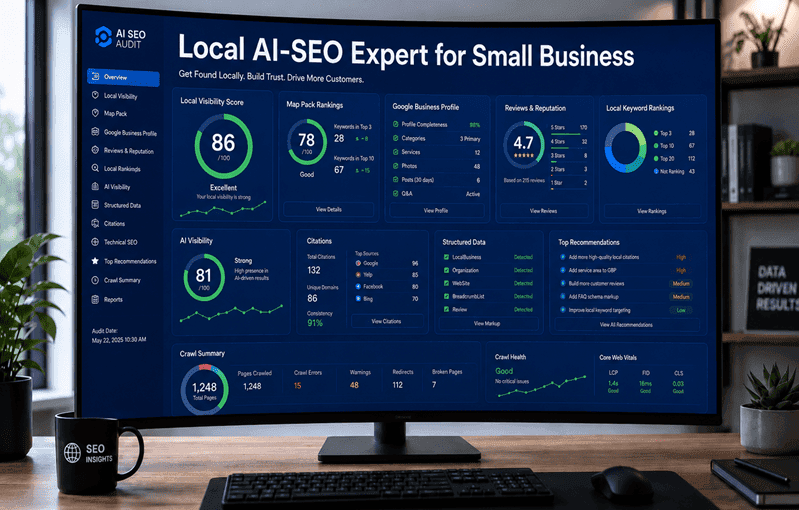
Most local businesses lose customers before they ever hear about it. Someone searches “plumber near me,” and Google shows a three-listing map block — the local pack — sitting above every other result. If you’re not one of those three, the search is effectively over.
Local SEO is the work of ranking your business in that local pack and in local organic results, so people searching nearby find you first. Nearly half of all Google searches now carry local intent, and the local pack appears in 93% of them — this isn’t a niche channel, it’s most local businesses’ primary way of getting found. That’s the whole idea in one sentence; everything below is how we actually do it.
If you’re evaluating whether your site has deeper technical problems too, our technical SEO audit is worth running alongside this. This page assumes you’re ready to focus specifically on local visibility, as part of a broader search visibility strategy.
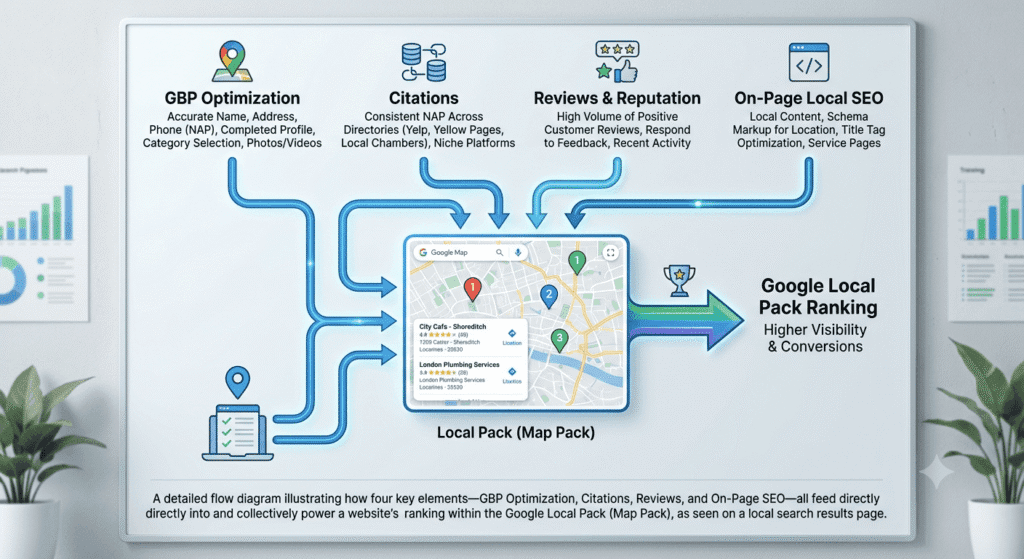
Your Google Business Profile carries more ranking weight than any other single factor. Per 2026 research from Whitespark and BrightLocal, GBP signals account for roughly 32% of local pack ranking weight. These figures come from annual practitioner surveys, not Google’s disclosed algorithm — treat the ordering as more reliable than the exact percentages, and treat proximity to the searcher as a hidden factor folded into that number, since it isn’t something any business can directly optimize.
That’s why the work starts with your profile, not your website. Category selection matters more than most business owners expect. Businesses that choose a well-considered primary category plus several accurate secondary categories rank meaningfully higher than those left on a default single category, per Whitespark’s research.
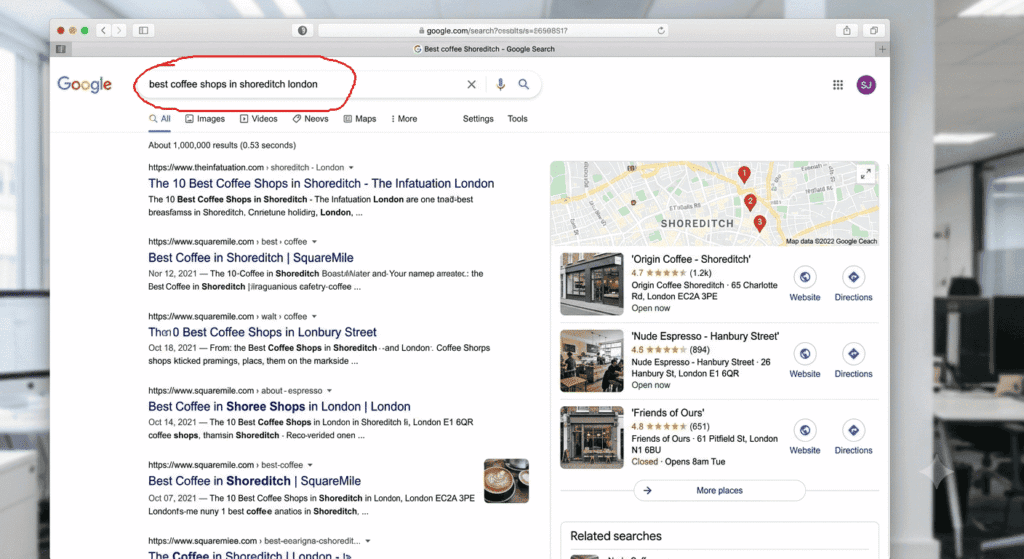
Completeness matters almost as much as accuracy. A fully filled-out profile — hours, services, photos, a real business description — earns roughly 7x more clicks than a bare-bones listing with just a name and address, according to Google’s own 2026 data.
Here’s how the major local pack ranking factors actually break down:
| Ranking factor | Approximate weight |
|---|---|
| Google Business Profile signals | 32% |
| On-page signals (NAP, local keywords) | 19% |
| Review signals (volume, velocity, sentiment) | 16% |
| Link signals | 15% |
| Behavioral signals (CTR, calls, dwell time) | 8% |
| Citation signals | 7% |
Per 2026 local ranking factor research compiled by Whitespark and BrightLocal. Treat the ordering as directional, not exact — Google has never disclosed real algorithmic weights.
Reviews deserve their own mention. Businesses with 50 or more Google reviews are 266% more likely to appear in the local pack than businesses with fewer than 10, per BrightLocal’s 2026 data. In our experience, reviews also do quieter work the ranking data doesn’t fully capture — they’re often what actually converts a click into a call once someone’s already looking at a listing, which is a separate effect from position alone.
In practice, the most common problem we find on a first audit isn’t a missing profile — it’s an inconsistent one. A business that’s changed address, added a location, or switched phone providers years ago, with the old details still sitting live on three or four directories nobody remembered to update. Cleaning that up alone often moves the needle before any new work even starts. Citation volume beyond that initial cleanup tends to matter far less than older local SEO advice suggests — we treat it as a one-time fix, not an ongoing lever.
Free local visibility check
We'll check your Google Business Profile, citations, and local pack position — no obligation.
Local search is shifting toward AI answer engines faster than most other categories. Per BrightLocal’s 2026 survey, the share of consumers using generative AI tools for local business recommendations jumped from 6% to 45% in a single year. That makes AI tools the third most popular source of local business recommendations, behind Google and word of mouth.
The reassuring part is that the signals overlap. A complete, accurate Google Business Profile, consistent citations, and a real base of reviews are exactly what an AI system needs to confidently recommend a business by name. This isn’t a separate optimization track from traditional local SEO — it’s mostly the same foundation doing double duty. Structured data plays a direct role here too: LocalBusiness schema gives AI systems a clean, machine-readable version of your hours, service area, and location, rather than asking them to infer it from page text.
That same logic extends to content depth, not just listings — a business with substantive, complete service pages reads as a stronger entity to an AI system than one with a single thin homepage, the same principle Topical Authority covers at the whole-site level.
This service fits any business with a physical location or a defined service area — a single-location dentist, a multi-location HVAC company, a plumber covering five surrounding towns. If customers ever search for you by “near me” or “[service] in [city],” this is the work that gets you found.
Multi-location businesses need a different scale of the same work. Each location needs its own optimized profile and consistent citations, plus service-area pages built so they don’t compete against each other for the same searches — a mistake we see often enough that it’s worth flagging here directly. Well-built service-area pages also start doing double duty as a form of topical authority, scoped to your location instead of your subject — see Topical Authority for the site-wide version of that idea.
Single-location businesses can usually see meaningful movement faster, since there’s less to coordinate. If your site also has deeper structural issues — orphaned pages, unclear site architecture — that’s worth addressing through technical SEO alongside this work, not instead of it.
Local pack clicks concentrate heavily at the top. Listings in the 3-pack’s top position receive substantially more traffic and customer actions than listings just outside it, and average click-through rate for top-3 local pack positions runs around 43%, per Nadernejad Media’s 2026 compiled local SEO data. The gap between position 3 and position 5 is the difference between real visibility and being functionally invisible to most searchers.
Separately, near-me searches convert at an unusually high rate. 76% of people who search for something nearby visit a business within 24 hours, per BrightLocal and Google’s compiled 2026 research — a second, independent figure pointing the same direction as the click-through data above.
What we can say honestly about our own work: our local SEO campaigns follow the same GBP-first, citation-and-review-backed process described above, applied consistently across client engagements. We don’t yet have a published, named case study specifically for local SEO to link here. That’s coming as current campaigns complete, and we’d rather say that plainly than dress up a number we can’t stand behind.
Google Business Profile, local pack, and near-me search data from published 2026 industry research — not a single-site report.
How much do local SEO services cost? Most businesses spend $500–$3,000 per month depending on competitiveness and location count, per 2026 pricing data from SEO.com and WebFX. Small, single-location businesses in lower-competition markets often land near $1,000/month. Multi-location or highly competitive markets — legal, medical, home services in major metros — commonly run $2,000–$5,000+.
What’s included in local SEO services? At minimum: Google Business Profile optimization, LocalBusiness structured data, citation building and NAP consistency across directories, review management, and monthly ranking reports. More comprehensive campaigns add local content, service-area pages, and local link building.
How long does local SEO take to work? Most businesses see initial movement within 3–6 months, with fuller traction in competitive markets taking 6–12 months, per the general consensus across current local SEO research. There’s no reliable way to promise a faster guaranteed timeline — anyone who does is skipping the actual work.
Is local SEO worth it for a small business? For any business with a physical location or service area, yes. Nearly half of all Google searches carry local intent, and the local pack appears in 93% of them. That’s not a niche channel — for most local businesses it’s the primary way new customers find them online.
Do I need local SEO if I already have AI search / GEO optimization? Yes, and they reinforce each other. The same GBP completeness, citation consistency, and review base that ranks you in the local pack is also what AI systems draw on to recommend a business by name — see AI Search Optimization for the AI-specific side of this work.
Does local SEO include structured data or schema markup? Yes — LocalBusiness schema is part of this service. It’s the machine-readable version of your hours, address, and service area, which both traditional search engines and AI systems use to confirm the details in your listing are accurate.
Ready to book a real look at your Google Business Profile and local listings? Book a free strategy call → No obligation, no generic pitch — just a straight answer on where you stand.


Trustpilot reviews

It was difficult to pick only one reasoning for the 5 star rating, in fact all the features are top notch. I love the design, and the pre built elements make your life a hell of a lot easier.

It was difficult to pick only one reasoning for the 5 star rating, in fact all the features are top notch. I love the design, and the pre built elements make your life a hell of a lot easier.
It was difficult to pick only one reasoning for the 5 star rating, in fact all the features are top notch. I love the design, and the pre built elements make your life a hell of a lot easier.
It was difficult to pick only one reasoning for the 5 star rating, in fact all the features are top notch. I love the design, and the pre built elements make your life a hell of a lot easier.

Adding {{itemName}} to cart
Added {{itemName}} to cart


