
Looking for collaboration for your next project? Do not hesitate to contact us to say hello.
Looking for collaboration for your next project? Do not hesitate to contact us to say hello.


We are here to answer any question you may have. Feel free to reach via contact form.
We deliver Technical SEO solutions designed to strengthen your website’s crawlability, indexability and search visibility.
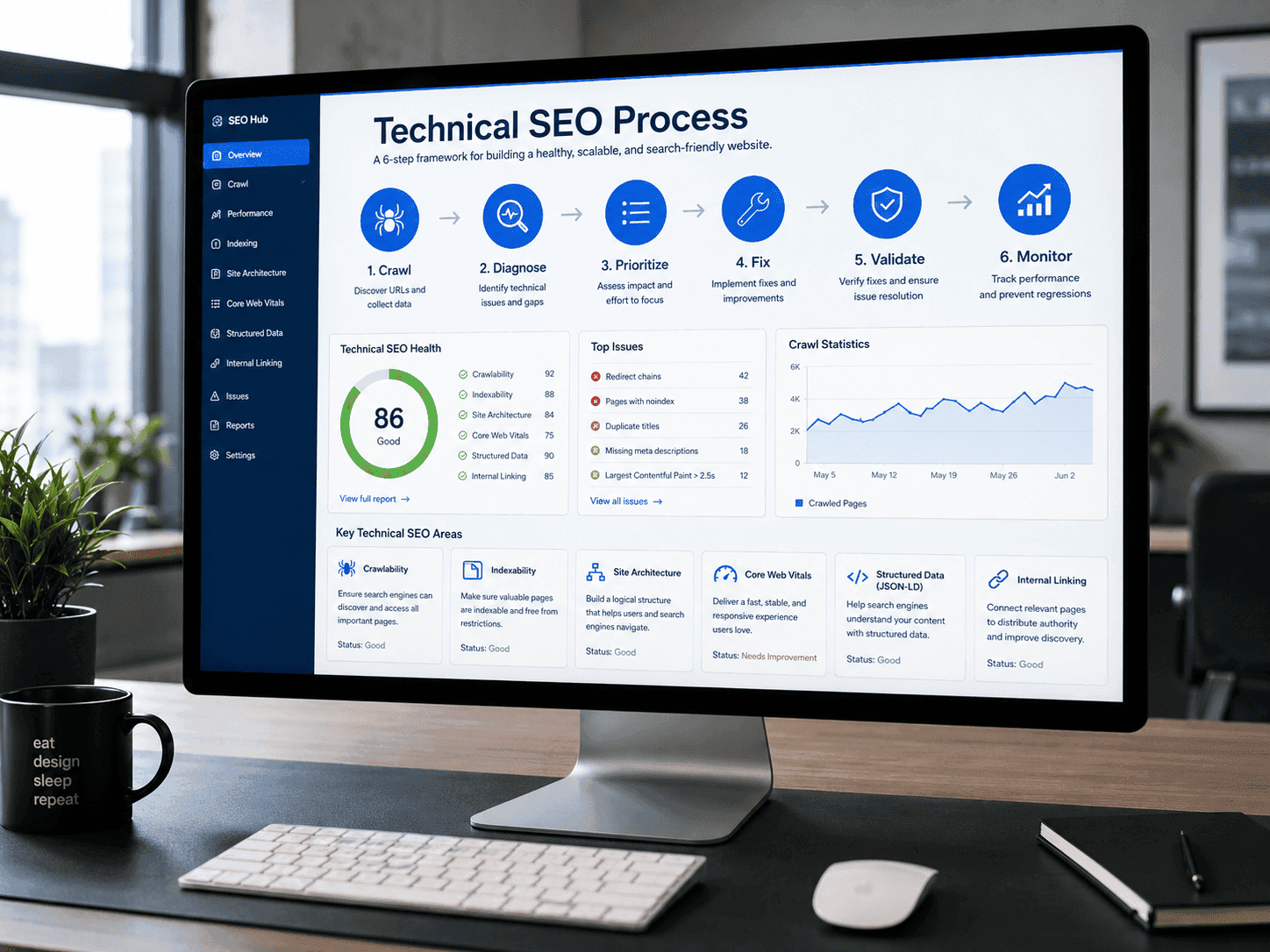
Type: Real technical SEO audit dashboard showing crawl errors, indexability issues, site architecture, and structured data checks Dimensions: 1200 × 630 px Alt text: Technical SEO audit dashboard showing crawl, indexing, and site architecture issues
Your website can look polished, load on your phone, and still make search engines work far too hard to understand it.
Pages may be excluded from Google’s index. Important content may sit too deep in the site. Duplicate URLs can waste crawl attention. JavaScript may hide key content. Internal links may point search engines in circles.
Technical SEO is the process of improving how search engines crawl, render, understand, and index a website.
SearchNextLevel Technical SEO focuses on finding the technical barriers between your content and search visibility, then fixing them in a measured order.
We don’t start by installing another plugin and hoping the warning lights turn green. We examine how the website actually behaves for users, crawlers, and search systems.
Technical SEO involves controlling how search engines discover URLs, process website content, select canonical pages, and decide which content is eligible for indexing.
That sounds tidy on paper.
Real websites rarely are.
A website can produce hundreds or thousands of unnecessary URLs through filters, parameters, tags, archives, search pages, staging environments, pagination, or poorly configured plugins.
At the same time, a commercially important page may have almost no internal links pointing to it.
That is the kind of contradiction we look for.
A crawler needs a logical route through your website.
We review:
A simple example is a service page that exists, is published, and appears in the XML sitemap but is not linked from the main site architecture.
Technically, the page is there.
Strategically, it is standing in a dark room waving.
SearchNextLevel looks at both URL discovery and the strength of the crawl path leading to important pages.
A crawled URL is not automatically an indexed URL.
We compare the URLs a business wants indexed with the pages search engines can actually discover and process.
The review may include:
The objective is not to force every URL into the index.
Some URLs should not be indexed.
The real work is deciding which URLs deserve search visibility and making the technical signals around those pages consistent.
A canonical tag is a signal that identifies a preferred version of similar or duplicate content.
But a canonical tag can conflict with other signals.
For example:
| Technical signal | URL A | URL B |
|---|---|---|
| Canonical tag | Points to URL A | Points to URL A |
| Internal links | 5 links | 200 links |
| XML sitemap | Included | Included |
| Redirect | None | None |
The canonical tag says URL A matters.
The internal architecture heavily promotes URL B.
The XML sitemap includes both.
That is not a clean technical message.
SearchNextLevel reviews canonicalization as a group of reinforcing signals rather than treating the canonical tag as a magic switch.
Site architecture determines how content is organized and connected.
For a local service business, a logical structure may connect the homepage to service pages and relevant location pages.
An ecommerce site has a different problem.
Products, categories, filters, variants, and pagination can create complex crawl patterns very quickly. Our ecommerce SEO work sits alongside this review whenever an ecommerce architecture is involved.
A SaaS site may need clear relationships between product features, use cases, integrations, documentation, and commercial pages.
We examine how the architecture supports:
A technically healthy architecture makes important content easier to find without generating endless low-value URL paths.
Modern websites can load content differently for browsers and search crawlers.
JavaScript is not automatically an SEO problem.
The question is whether important content, links, metadata, and page functionality remain reliably accessible during rendering.
We investigate issues such as:
SearchNextLevel focuses on the practical outcome: can search systems reliably access the content and relationships the business needs them to understand?
Performance matters because slow and unstable pages create a poor experience and can expose deeper technical problems.
We examine Core Web Vitals and related performance behavior alongside the site’s actual implementation.
That can include:
How to work through LCP, INP, and CLS — with Google's official thresholds and the most common fixes for each
We do not recommend removing half the website simply to chase a prettier performance score.
A booking form may be commercially necessary. An analytics script may support measurement. An ecommerce function cannot disappear because a testing tool dislikes it.
The goal is to improve performance while preserving what the website needs to do.
Get a free technical SEO audit review and identify the issues most likely to affect crawling, indexing, or site performance.
Technical SEO helps AI-powered search systems access and process clear, consistent, well-structured web content.
It does not guarantee a citation in Google AI Overviews, ChatGPT, or Perplexity. No single technical fix does.
AI-search visibility can depend on multiple reinforcing signals, including content quality, entity clarity, source reputation, topical depth, corroboration, and retrievability. Technical SEO supports that ecosystem — it removes friction, it doesn’t buy placement.
A search or AI system cannot make strong use of information it cannot reliably retrieve.
Technical problems can create uncertainty around:
Cleaner technical signals reduce unnecessary ambiguity.
Valid structured data can describe entities, services, products, organizations, breadcrumbs, articles, and other supported content types. Our schema markup implementation work is built around this.
Schema markup should match visible page content.
It should also use appropriate Schema.org types and follow applicable search-platform requirements when rich-result eligibility is a goal.
Structured data is not an AI citation button. It is one way of making certain relationships and attributes more explicit for machines.
Internal links do more than help users move between pages.
Descriptive links can show relationships between a technical SEO service, a website audit, schema markup implementation, ecommerce SEO, and other relevant subjects.
A disconnected collection of pages is harder to interpret than a deliberately connected content system.
This is particularly important as search expands beyond ten blue links.
Search systems increasingly need to retrieve precise passages and connect information to businesses, services, products, and other entities.
Technical clarity supports that process.
Real, publicly sourced data on crawl behavior, indexability, site architecture, and structured data across the web — updated July 2026
Share of origins achieving a "Good" rating across LCP, INP/FID, and CLS combined
Source: HTTP Archive, The Web Almanac 2025 (Performance chapter), CrUX field data
Share of crawled pages implementing each markup format
Source: HTTP Archive, The Web Almanac 2024 (Structured Data chapter)
Page-level adoption climbing steadily year over year
Source: HTTP Archive, Web Almanac 2022 & 2024. Note: W3Techs reports 51.5% (Aug 2025) using a site-level rather than page-level sample — different methodology, same upward trend.
Across ~14 billion analyzed pages
Source: Ahrefs, "Search Traffic Study"
Verified, dated developments affecting crawling, indexing, and structured data
Sources: Google Search Central / crawling-infrastructure documentation; Schema.org release notes; Schema.org blog (June 4, 2026); European Commission DMA proceedings coverage.
Want your own site checked against these benchmarks?
SearchNextLevel.com — Technical SEO Services
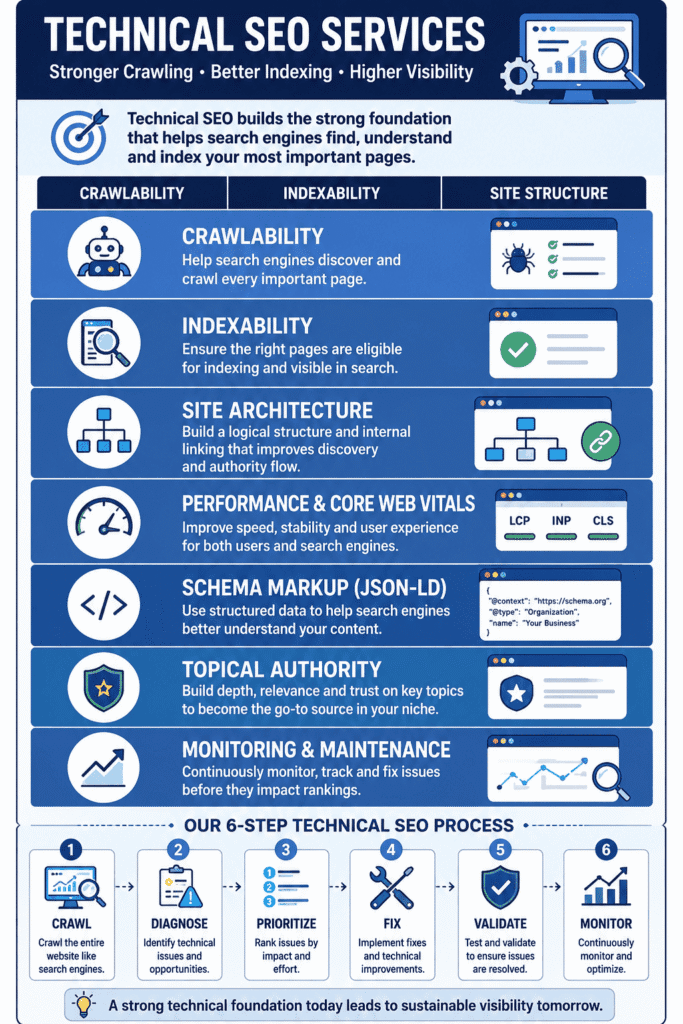
Crawl → Diagnose → Prioritize → Fix → Validate → Monitor — with the checks and outputs at every step
We begin by examining the website from several technical viewpoints.
Depending on the project, this may involve crawl data, Google Search Console information, sitemap analysis, server responses, structured data testing, page performance diagnostics, and manual checks.
One tool rarely tells the whole story.
A crawler may identify a canonical tag.
Google Search Console may show that Google selected a different canonical.
The useful information is often in the difference.
We separate symptoms from causes.
A page being excluded from indexing is a symptom.
The cause may involve duplication, weak internal discovery, canonical conflicts, rendering, low-value URL patterns, or several issues working together.
We document the likely technical mechanism before recommending a fix.
Not every technical warning deserves immediate developer time.
We prioritize based on:
A broken internal link on an old blog post and a canonical problem affecting an entire product category should not sit in the same priority bucket.
Most audit tools will happily give both a warning icon.
We add the judgment.
SearchNextLevel can provide implementation guidance or work through the technical changes within the agreed project scope.
Fixes may involve:
For complex development changes, we document the issue, affected URLs, expected behavior, and validation method.
That gives a developer something more useful than “please fix SEO.”
A technical fix is not finished when someone clicks Update.
We recrawl affected sections and test the intended behavior.
We may verify:
Where relevant, search-platform reporting is monitored after implementation.
Some changes can be validated immediately.
Search engine processing and index changes may take longer and remain outside an agency’s direct control.
Websites change.
New plugins are installed. Developers release code. Products are removed. Page templates are redesigned. Marketing teams launch campaigns at 4:57 p.m. on Friday.
Technical SEO monitoring helps identify when new problems appear.
We focus monitoring on issues relevant to the website rather than sending a monthly PDF containing 700 warnings nobody intends to read.
Judgment is the deliverable as much as the fix list.
Technical SEO is most useful for websites where search visibility depends on many pages, complex systems, or important commercial content.
A local business may need technical SEO when important service or location pages are not being indexed consistently.
Common problems include duplicated location content, broken redirects after a redesign, poor internal linking, conflicting sitemap settings, and slow mobile pages.
For example, a plumber may have a strong main service page but weak technical connections to emergency plumbing, drain cleaning, and individual service-area pages.
The problem is not always “more content.”
Sometimes the existing pages need a clearer technical structure.
Ecommerce websites can create large numbers of URLs through categories, filters, parameters, variants, and internal search systems. Our dedicated ecommerce SEO service extends this review into product-specific structured data and category architecture.
Technical SEO can help review:
The aim is to help search engines focus on commercially useful pages while avoiding unnecessary URL duplication.
SaaS websites often expand through feature pages, use cases, integration pages, comparison content, documentation, and programmatic page templates.
Technical SEO helps keep that growth organized.
We review whether the architecture clearly connects the product to its features, audiences, integrations, and supporting resources.
We also examine indexation patterns before a scalable publishing system turns a small technical problem into a very large technical problem.
Technical SEO can remove barriers that prevent strong pages from being crawled, processed, or indexed as intended.
The exact outcome depends on the website, competition, content quality, authority, and the technical issue being addressed.
SearchNextLevel focuses on capabilities we can actually evaluate:
What it can’t do is turn a weak page into the best answer for a competitive search query. It removes avoidable technical confusion and creates a stronger foundation for content, authority, and search visibility work — the rest is a separate job.
A technical SEO audit examines how search engines crawl, render, understand, and index a website.
The exact scope depends on the site, but a comprehensive review can cover crawl errors, indexing, canonicalization, redirects, robots directives, XML sitemaps, internal links, site architecture, JavaScript rendering, structured data, and performance.
SearchNextLevel also prioritizes findings by likely impact.
A long list of warnings is not the same thing as a technical SEO strategy.
Indexing gaps, unexplained traffic changes, duplicate URLs, crawl errors, poor Core Web Vitals, and important pages missing from search can indicate technical SEO problems.
However, some serious technical issues have no obvious visual symptom.
A website can appear completely normal to a business owner while serving conflicting canonical tags or blocking sections through crawler directives.
A technical crawl combined with search-platform data is usually the most reliable starting point.
Technical SEO can improve the conditions required for search visibility, but it cannot guarantee higher rankings.
Fixing an indexing problem may make a page eligible to appear in search.
Improving internal architecture may make important pages easier to discover and understand.
The page still needs useful content, relevance, and sufficient competitive signals for the queries it targets.
Technical SEO removes barriers. It does not replace the rest of SEO.
Some technical SEO changes can be validated immediately, while search engine processing can take longer.
A redirect, canonical tag, or robots directive can be tested as soon as the implementation is live.
Changes in crawling, indexing, and search visibility depend on when search engines revisit and reprocess affected URLs.
The scale of the website also matters.
Correcting one service page is different from resolving a template problem across 100,000 ecommerce URLs.
Fixing an indexing problem may make a page eligible to appear in search.
Improving internal architecture may make important pages easier to discover and understand.
The page still needs useful content, relevance, and sufficient competitive signals for the queries it targets.
Technical SEO removes barriers. It does not replace the rest of SEO.
Technical SEO can improve the conditions required for search visibility, but it cannot guarantee higher rankings.
Fixing an indexing problem may make a page eligible to appear in search.
No. Small business websites can have serious technical SEO problems too.
A five-page website can accidentally block crawlers, noindex its main service page, create redirect loops, or use conflicting canonical tags.
Larger sites usually have more opportunities for technical problems to scale.
Smaller sites can still be heavily affected when a problem touches one of their few important pages.
The page still needs useful content, relevance, and sufficient competitive signals for the queries it targets.
Technical SEO removes barriers. It does not replace the rest of SEO.
Yes. Structured data implementation is commonly treated as part of technical SEO because it provides machine-readable information about supported entities and page content. See our schema markup implementation service for the detailed process.
Schema markup needs to be valid, relevant, and consistent with visible content.
Adding more schema types does not automatically improve search visibility.
The objective is accurate structured information, not the largest JSON-LD block possible.
Fixing an indexing problem may make a page eligible to appear in search.
Improving internal architecture may make important pages easier to discover and understand.
The page still needs useful content, relevance, and sufficient competitive signals for the queries it targets.
Technical SEO removes barriers. It does not replace the rest of SEO.
You do not need another automated score telling you that 312 issues are “urgent.”
You need to know what is actually affecting your website, which problems matter first, and what should be fixed.
Curious what’s holding your pages back? Get a free Technical SEO audit review from SearchNextLevel.
We’ll examine the site’s technical foundation and identify the most important crawl, indexing, architecture, structured data, or performance issues we can see. See also our standalone website audit service if you want the full-site review on its own.
Start with the problem. Then build the fix.


Trustpilot reviews

It was difficult to pick only one reasoning for the 5 star rating, in fact all the features are top notch. I love the design, and the pre built elements make your life a hell of a lot easier.

It was difficult to pick only one reasoning for the 5 star rating, in fact all the features are top notch. I love the design, and the pre built elements make your life a hell of a lot easier.
It was difficult to pick only one reasoning for the 5 star rating, in fact all the features are top notch. I love the design, and the pre built elements make your life a hell of a lot easier.
It was difficult to pick only one reasoning for the 5 star rating, in fact all the features are top notch. I love the design, and the pre built elements make your life a hell of a lot easier.

Adding {{itemName}} to cart
Added {{itemName}} to cart


