
Looking for collaboration for your next project? Do not hesitate to contact us to say hello.
Looking for collaboration for your next project? Do not hesitate to contact us to say hello.


We are here to answer any question you may have. Feel free to reach via contact form.
We deliver Structured Data and Schema Markup solutions designed to improve how your website’s content, entities, products and services are understood, interpreted and presented across Google and AI-powered search.

Most sites have a Google Business Profile, a decent title tag, maybe a blog. What they don’t have is any machine-readable explanation of what they actually are — so search engines and AI systems are left guessing whether a page is a service, a product, an article, or a local business, from context clues alone.
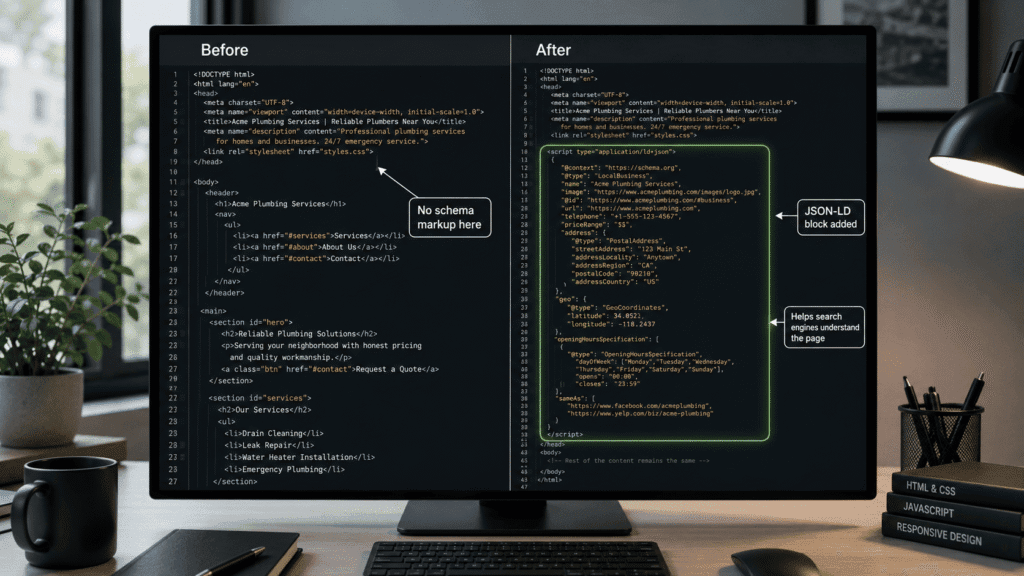
Structured data is machine-readable code — usually JSON-LD — added to a page that tells search engines and AI systems exactly what the content means, not just what it says. That’s the whole idea in one sentence; everything below is how we actually do it.
This work already touches several of our other pages — Local SEO covers LocalBusiness schema, Ecommerce SEO covers Product schema and merchant feed alignment, and SEO Audit checks for structured data gaps as part of a full review. This page is the deep dive — the dedicated service for sites that need schema done properly across the board, not as a line item inside something else.
Three terms get used interchangeably, and they shouldn’t be. Structured data is the broad concept — any information organized so machines can read it without guessing. Schema.org is the shared vocabulary — the actual list of types (Organization, Product, Article) and properties (name, price, author) that Google, Bing, and every major AI system agreed to support back in 2011. JSON-LD is the format we actually write it in — a small script block in the page’s <head>, invisible to visitors, that Google explicitly recommends over the two older formats (Microdata and RDFa) because it doesn’t touch your page’s visible HTML at all.
Google has been direct about this: structured data is not itself a ranking factor. What it does is remove ambiguity. A page can rank on content quality alone — but a page with clean, accurate schema is easier for a search engine or an AI system to trust and cite correctly, and that trust compounds on pages that already rank well.
There’s real evidence behind this. Backlinko’s research found 72% of Google’s first-page results use some form of schema. Separately, the HTTP Archive’s Web Almanac found JSON-LD now appears on roughly 41% of all pages — up from 34% two years earlier, and still well short of universal. A controlled 2025 experiment from Search Engine Land tested three near-identical pages differing only in schema: the page with well-implemented JSON-LD got indexed, ranked position 3, and appeared in a Google AI Overview. The page with no schema never got indexed at all.
We should be straight about the limits, too. Google confirmed in 2025 that structured data gives a real advantage, and Microsoft’s Bing team confirmed the same for Copilot — but Google has explicitly said it hasn’t confirmed that FAQPage schema directly drives AI Overview or AI Mode citations, and Google removed FAQ rich results from search entirely on May 7, 2026. Schema isn’t magic, and any vendor telling you it guarantees AI visibility is skipping that part.
Here’s how the three related terms actually break down:
| Term | What it is | Example |
|---|---|---|
| Structured data | The broad concept | Any machine-readable data format |
| Schema.org | The shared vocabulary | Organization, Product, Article, LocalBusiness types |
| JSON-LD | The format we write it in | A script block in the page <head>, Google’s recommended syntax |
Free schema check
We'll check your structured data against what search engines and AI systems actually need — no obligation.
Structured data has become one of several signals AI systems lean on to decide whether they can trust and cite a page — not the only one, but a real one. A 2026 benchmark study across 500+ brands found that brands shipping 9 or more structured product facts achieved roughly 78% average AI citation coverage, against just 9% for brands with two or fewer, per Erlin AI’s research.
Separately, Alhena.ai’s 2026 analysis found that 65% of pages ChatGPT actually cites include structured data — a real correlation, though not proof that schema alone causes the citation.
The honest version of this story: AI systems don’t crawl schema markup directly. They rely on the structured understanding search engines and knowledge graphs already build using schema extensively — so clean structured data feeds the systems AI answers draw from, rather than being read by the AI model itself in real time. It’s an indirect but genuine mechanism, not a direct shortcut.
This service fits any business whose site is missing schema entirely, or has it implemented inconsistently — plugin-generated markup that doesn’t match the actual page, duplicate Product schema from a WooCommerce conflict, or a LocalBusiness block with the wrong hours. If you’ve never had a real schema audit, there’s a good chance something on your site is either missing or quietly wrong.
It’s a particularly good fit alongside technical SEO work, since schema errors often surface during the same crawl-and-index review. Ecommerce brands and multi-location local businesses tend to have the most schema complexity — see Ecommerce SEO and Local SEO for how this work plugs into those specific services.
Incorrect implementation carries real risk, not just missed opportunity — markup that misrepresents what’s actually on the page can trigger a Google manual action, which is exactly why validation is a standing step in our process, not an afterthought. One reported 2026 case from a service-area business found that correcting LocalBusiness and service-area schema was associated with a 30–60% increase in nearby-search rankings, per Innovative Group’s case writeup — a single reported example, not a guaranteed outcome, but a real, sourced data point in the direction the broader research above points.
What we can say honestly about our own work: our schema implementations follow the same audit-prioritize-validate process described above, applied consistently across client sites. We don’t yet have a published, named case study specifically for this service to link here. That’s coming as current engagements complete, and we’d rather say that plainly than dress up a number we can’t stand behind.
Adoption, AI-citation, and platform data from published 2025–2026 industry research — not a single-site report.
Do I actually need schema markup in 2026? Yes, though not for the reason most people think. It won’t guarantee AI citation or rankings on its own, but 72% of Google’s first-page results already use some form of it, and it’s one of the clearest ways to remove ambiguity about what your content actually is — for both search engines and AI systems.
What’s the difference between structured data, schema, and JSON-LD? Structured data is the broad concept. Schema.org is the specific vocabulary of types and properties. JSON-LD is the format — a code block Google recommends — that we actually write that vocabulary in.
How much does schema markup implementation cost? A standard business site audit and implementation typically runs $1,000–$2,600 depending on site size and schema complexity, based on current UK-market agency pricing converted to USD; ecommerce sites with schema across thousands of product pages scale up from there.
Does FAQPage schema help me show up in AI Overviews? Not confirmed. Google has said it hasn’t verified that FAQPage schema directly drives AI Overview or AI Mode citations, and Google removed FAQ rich results from traditional search entirely in May 2026. It’s still reasonable to keep for genuinely helpful Q&A content, just not as a guaranteed AI-visibility tactic.
Can bad schema markup hurt my site? Yes — markup that misrepresents your actual page content risks a Google manual action. This is exactly why validation against Google’s Rich Results Test is a required step in our process, not optional.
Ready to find out exactly where your structured data has gaps? Get your free AI search audit → No obligation, no generic pitch — just a real look at what’s actually implemented on your site.


Trustpilot reviews

It was difficult to pick only one reasoning for the 5 star rating, in fact all the features are top notch. I love the design, and the pre built elements make your life a hell of a lot easier.

It was difficult to pick only one reasoning for the 5 star rating, in fact all the features are top notch. I love the design, and the pre built elements make your life a hell of a lot easier.
It was difficult to pick only one reasoning for the 5 star rating, in fact all the features are top notch. I love the design, and the pre built elements make your life a hell of a lot easier.
It was difficult to pick only one reasoning for the 5 star rating, in fact all the features are top notch. I love the design, and the pre built elements make your life a hell of a lot easier.

Adding {{itemName}} to cart
Added {{itemName}} to cart


